

Currently, conventional actuator systems have a complex mechanics that generate noise and vibrations, which can cause premature wear or disrupt other mechanical elements of the system. This complex and heavy construction also results in a large size which limits its integration in restricted environments. Furthermore, in the case of actuation and displacement measurement on the same side, additional sensor components are also required. The quality and thus the realistic simulation of feedback in combination with limited space available are difficult challenges for a switch. Finally, today’s conventional actuators have a high energy consumption and require maintenance, which results in high operating costs.
The last decade saw a rising interest towards alternative low-energy consumption actuation technologies and “smart materials”.
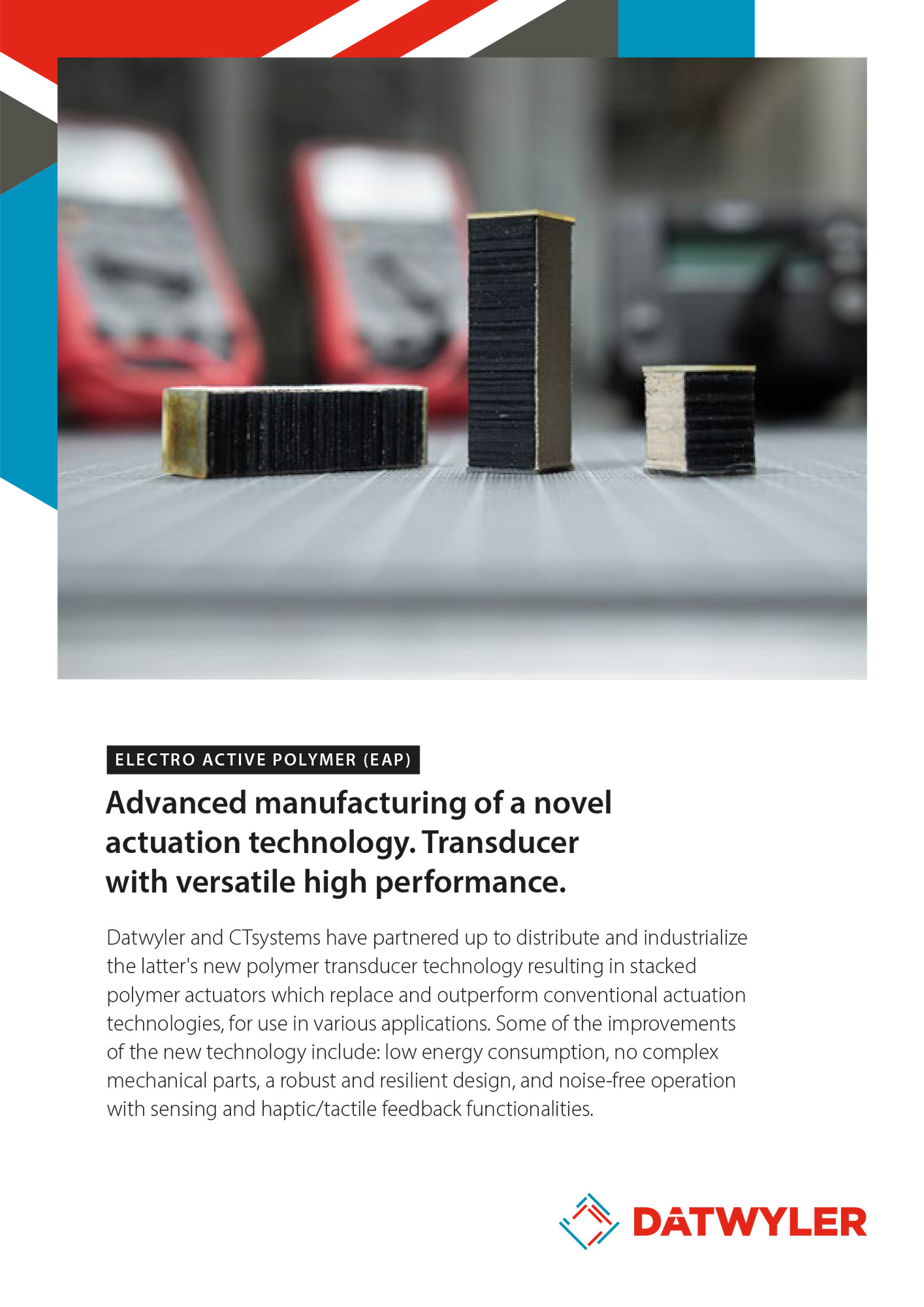
Datwyler is on the path to industrialize a new polymer transducer technology (“Electroactive Polymers” or EAPs) based on stacked polymer actuators, which was originally developed by CTsystems, a spin-off from EMPA, Switzerland. EAPs can replace and outperform conventional actuator technologies and can be used in various applications. Advantages of EAPs include low energy consumption, no additional complex mechanical parts, a robust and resilient design, noise-free operation with the possibility for energy harvesting, sensing, and haptic/tactile feedback functionalities.
A flexible solution for numerous applications.
新闻动态


Solution
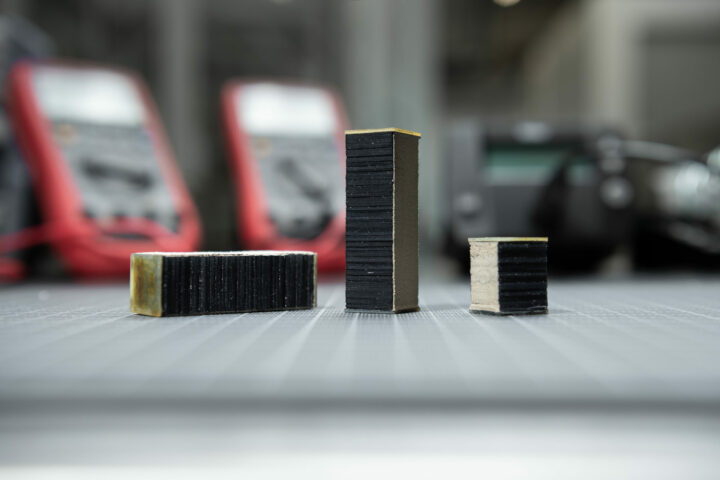
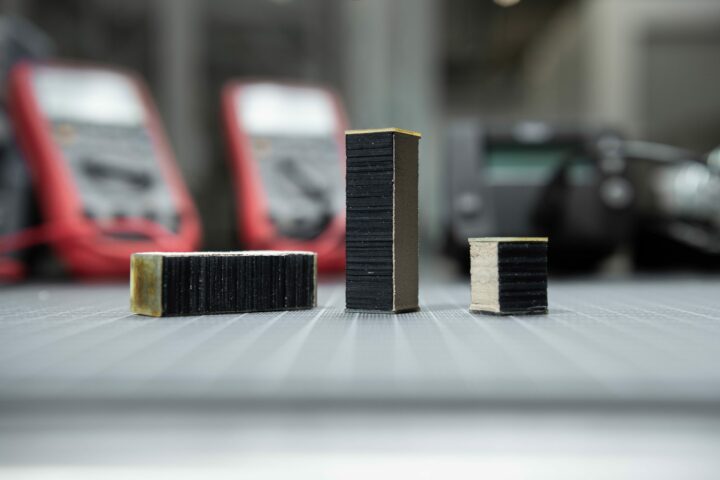
The stacked design of the new multi-layer actuator allows high contraction movement and tension force capabilities.
The particular design of the dielectric elastomer used in the actuator, is based on a series of flexible capacitors electrically connected in parallel to alternating polarities of each layer. This new arrangement makes EAP technology suitable for a wider range of potential applications.
These elastomers have the particularity of being silent and generating no vibration. In addition, this new technology directly integrates sensing functionalities (no additional sensor components) which makes the actuator more compact. These two parameters make the integration of this new solution optimal in restricted and mechanically precise systems.
The same sensing functionalities are enhanced by offering short response time, adaptable amplitude shapes and a wide frequency range. This makes its use much more interesting for haptic/tactile human machine interfaces.
Finally, the energy consumption of the new actuator is significantly lower than those of conventional actuators, which therefore reduces the operating costs of the mechanical system that integrates them.
How it works

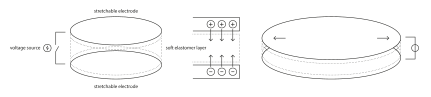
Electro-mechanical transducer made of soft and elastic polymer.

Electrical power turns into mechanical motion by elastic deformation.

Our unique thin layer dielectric elastomer stacks allow tactile and sensitive actuation and sensing.

Reliable electrostatic working principle for multipurpose and efficient operation.
Key benefits
Position holding
Green, efficient and mobile application
with very low energy consumption (close to nothing).
Stepless proportional positioning
Light weight, solid and compact size
by voltage governed stroke.
Actuation and sensing
Cost-saving monoblock and integration with simultaneous actuation and sensing capability
allowing high versatility of operation.
Macro scale stroke
Resilient, enduring design
through low material stiffness, high insulation.
Noise free actuation
Maintenance and noise free
thanks to stroke by pure material deformation.
Low-cost device
given by processing technology driven costs.
Compact and lightweight
constituted by high energy density.
APPLICATION
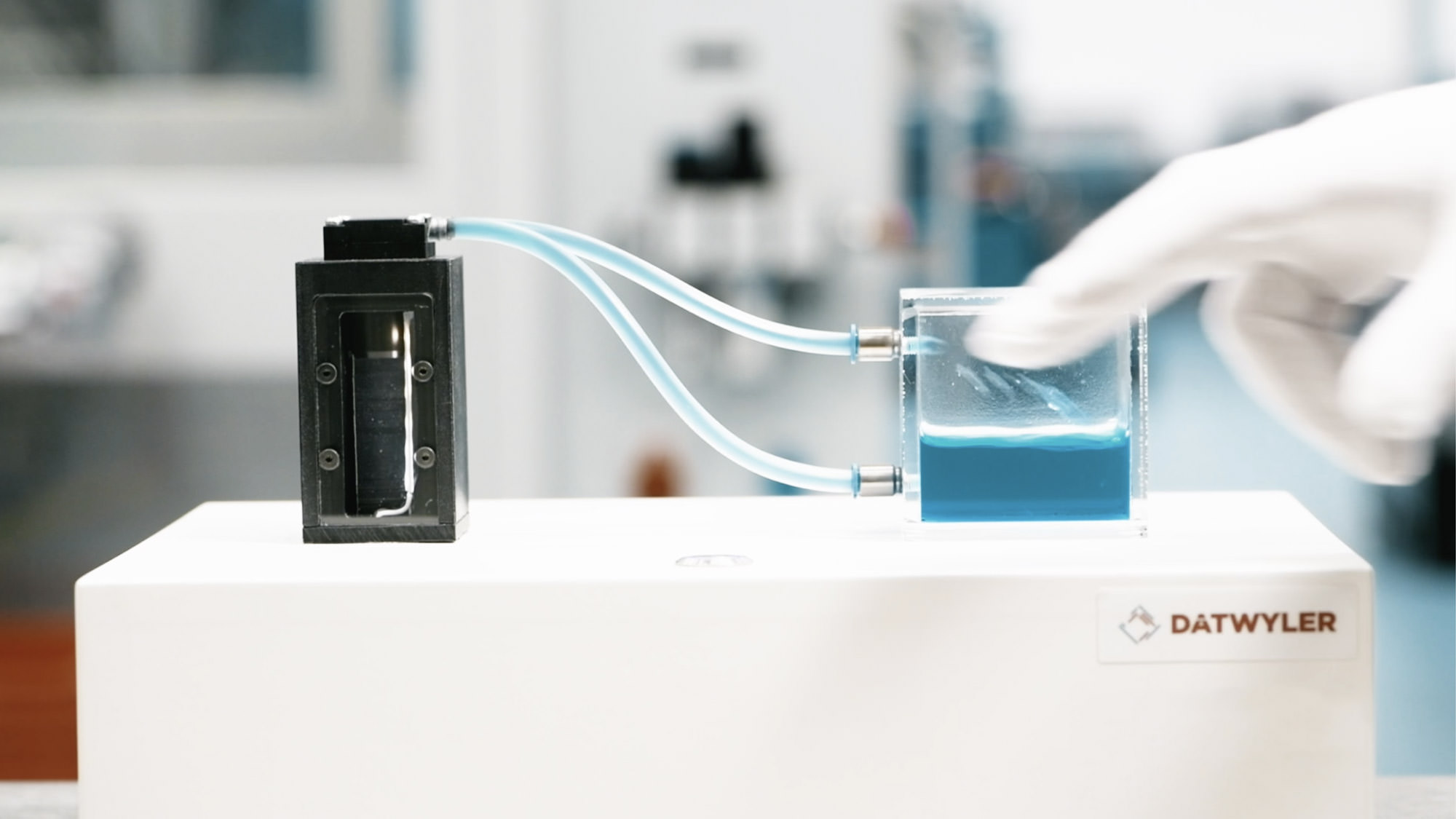
EAP Pump demonstrator with adaptive fluid control
General properties
20N
Max. actuation force (dependent on stack dimensions)
10 %
Max. contraction
unter 2 ms
Actuation time (dependent on stack dimensions)
50 Hz
Actuation frequency (dependent on stack dimensions)
-40°C bis +130°C
Temperature resistance
德特威勒相关媒体报道



The automotive technology magazine ATZ reports on actuators made of electroactive polymer for automotive interior elements in a technical article by Datwyler.
 ATZ Issue 10/2024 |
01.10.2024
ATZ Issue 10/2024 |
01.10.2024
 Read the whole publication


The European trade magazin Plastic Insights reports on how Datwyler’s Dielectric Elastomer Actuator technology is to be transferred to series production this year with the first lead customers.
Plastic Insights, Volume 2024 Issue 6 |
01.06.2024
Read the whole publication

The German trade journal Elektro.net reports on the advantages of the new technology of dielectric elastomer actuators.
Elektro.net |
07.05.2024
Read the whole publication

The German trade media Elektronik Praxis explains in an article the advantages of stacked electroactive polymers from Datwyler compared to conventional actuators.
Elektronik Praxis |
01.12.2023
Read the whole publication

A deeper look at the trend towards electrification and the possibilities surrounding haptic feedback. Haptic feedback is an example of these advances and is an area that is increasingly important in terms of vehicle design, both in terms of aesthetics and functionality.
Automotive World |
26.11.2021
Read the whole publication

Publication

Innovative solution for novel actuation technology

pdf,
28.35 MB (en)