Transportation & Electronics

Navigating the PFAS Challenge: Datwyler Delivers End-to-End Solutions for Compliance, Performance, and Real-World Scalability

flag-icon

遗憾的是,此页面的内容没有中文版

用谷歌翻译

Article | 25. June 2026

PFAS regulations grow increasingly urgent for global manufacturers as regional legislation consolidates. Fluorinated polymers may not face an urgent ban but might be subject to a step-wise phase-out with use-specific derogation periods, likely accompanied with specific and demanding risk mitigation measures.

For high-end sectors, selecting the right material is crucial to ensure long service lives and safety conditions. In the past, FKMs seemed to be the only reliable choice when it came down to extreme temperatures and aggressive media, which makes PFAS transition far more than a compliance issue: it demands a full reassessment of traditional material strategies combined with advanced product design and validation techniques.

For some applications, fluorosurfactant-free FKMs will remain the only logical choice; for others, alternatives may be found equally suitable. At Datwyler, we strongly believe a successful transition must be application-led.

As a global leader in polymer materials and sealing systems, we’ve advanced the development of our NFS fluorosurfactant-free FKM portfolio and completed our first full working-condition validation for alternative compounds, always working closely with our customers – helping you move from compliance preparedness to technical readiness.

The next phase of PFAS transition will not only be defined by one-for-one material swaps, but by engineered, application-specific matching of materials, design, and manufacturing.

Regulation is accelerating technical decisions

Globally, the regulatory landscape continues to evolve – albeit at varying paces regionally. Europe remains the leading driver, while the US is combining federal and state-level activity and Asia is advancing through its own frameworks. For global OEMs and suppliers, that creates a practical reality: products are rarely developed for one market alone, and over time it becomes increasingly difficult to sustain multiple material strategies across regions.

Qualification cycles can be long, and late-stage material change is rarely simple. Screening, validation and industrialization all take time, especially where components must demonstrate reliable performance under temperature cycling, chemical exposure, vibration or electrical stress. The question is therefore shifting from whether change is coming to how it can be managed without compromising reliability or creating gaps in continuity.

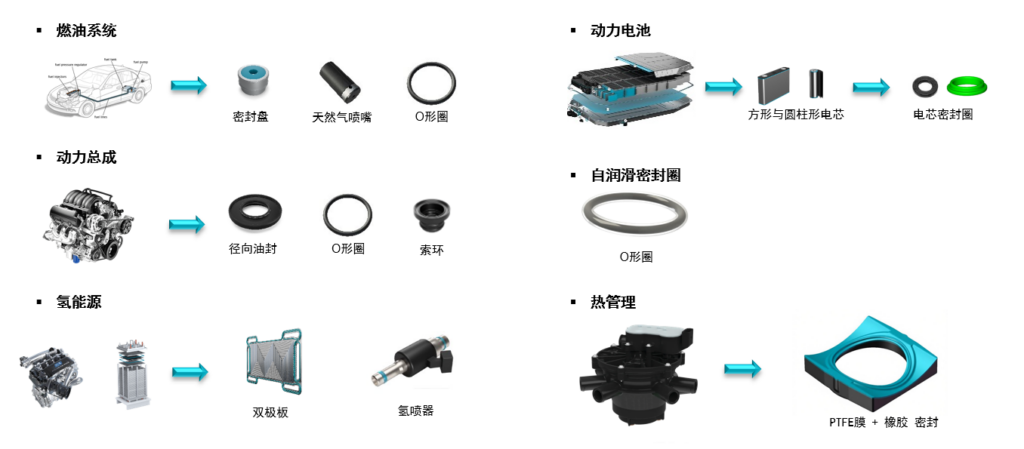
NFS fluorosurfactant-free FKM potential applications

Application requirements lead material choice

In essence, this means PFAS transition should no longer be treated as a chemistry decision alone. It has to be led by the application and be solved with the help of part design and simulation. A high-voltage connector presents a different challenge from a battery cell seal. Hydrogen applications have a different set of demands from a gasket in thermal management. Media, temperature, geometry, ageing profile and system function all need to be considered together.

What makes this particularly complex is that FKM has traditionally been used where resistance to aggressive media and elevated temperature performance need to be combined. That unique property profile cannot easily be met by other polymer types. Comparative screening of FKM against VMQ, EPDM, NBR, HNBR and AEM identified solutions either meeting high temperature or media resistance requirements. Some alternatives can approach individual performance targets, meeting both demands – elevated temperature and media resistance – but not without trade-offs.

Core competencies matter more as complexity rises

That is also why Datwyler’s core competencies matter most when the material decision becomes more complex. Material expertise is only one part of the response. Internal mixing know-how, screening capability and analytical testing help determine how compounds behave under relevant conditions. Solution design helps convert those findings into component concepts that can perform in the intended application. Co-engineering becomes important where design adaptation can open the door to alternative polymers that would not work in an unchanged assembly. Product industrialization then determines whether a promising solution can be produced at scale with the consistency customers require.

It also reflects a broader principle that runs through Datwyler’s work. Reliability is not treated as the property of a single material alone. It is the result of design precision, process control, simulation, validation and scalable production working together.

The next phase will be defined by engineering, not substitution alone

For manufacturers, the task now is not only to monitor regulation, but to decide where technical transition should begin and how to do it without compromising performance. As electrification, advanced sensors and higher-density electronics continue to shape the market, that balance between compliance, reliability and manufacturability will become even more important.

The companies best placed to manage it will be those that treat PFAS transition not as a late-stage constraint, but as a structured engineering program with long-term system performance in view. That is increasingly where the discussion now sits: less in general expectation, and more in the practical work of matching materials, designs and production strategies to the realities of the application. If you’re facing PFAS transition challenges, contact Datwyler today for tailored, high-performance solutions.


Contact

Please contact us for more information.